ComBlu’ s fourth annual study, State of Online Branded Communities, offers a view of how some of the biggest and most respected brands approach online community and integrate it within their overall social ecosystem. Readers of the previous three years of “State of Online Branded Communities” report know that ComBlu broadly defines community as an engagement ecosystem that has no walls. Community includes offline conversations, social networks, review sites, gated brand communities and content hubs. People looking for answers about product performance and service experience, as well as those wanting to share their expertise or find others with similar interests or challenges do not limit themselves to a single digital or social channel. In fact, depending upon the industry sector, people seek connection in over10 different places before making a buying decision according to ZMOT. Brands engage today because they want to create affinity with stakeholders and tap them as a powerful post-purchase channel. As such, these stakeholders provide product and service insights, enhance product offerings, and contribute influence at multiple points of the buying journey of others.
This requires brands to be present where conversations occur as well as provide stimuli for deeper or new conversations. So who’s doing a great job?
This year, ComBlu introduced its lumen ratings to indicate performance tiers for the study.
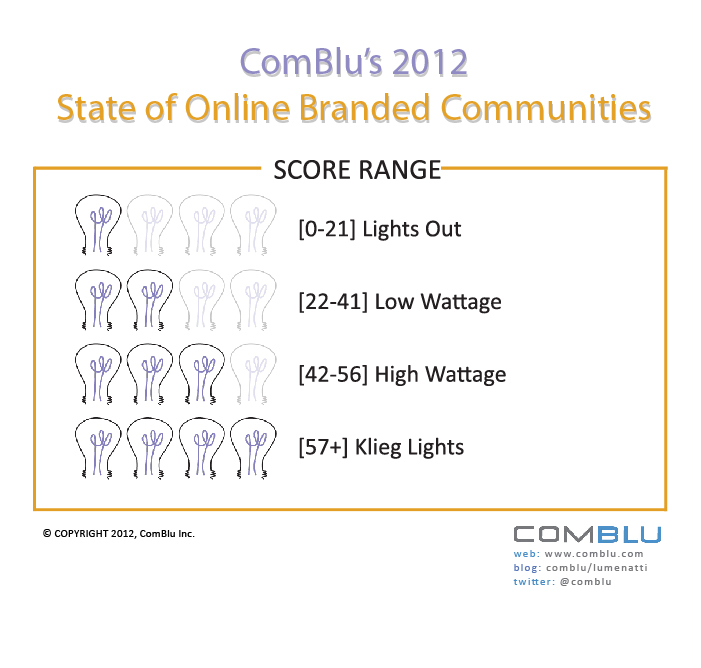
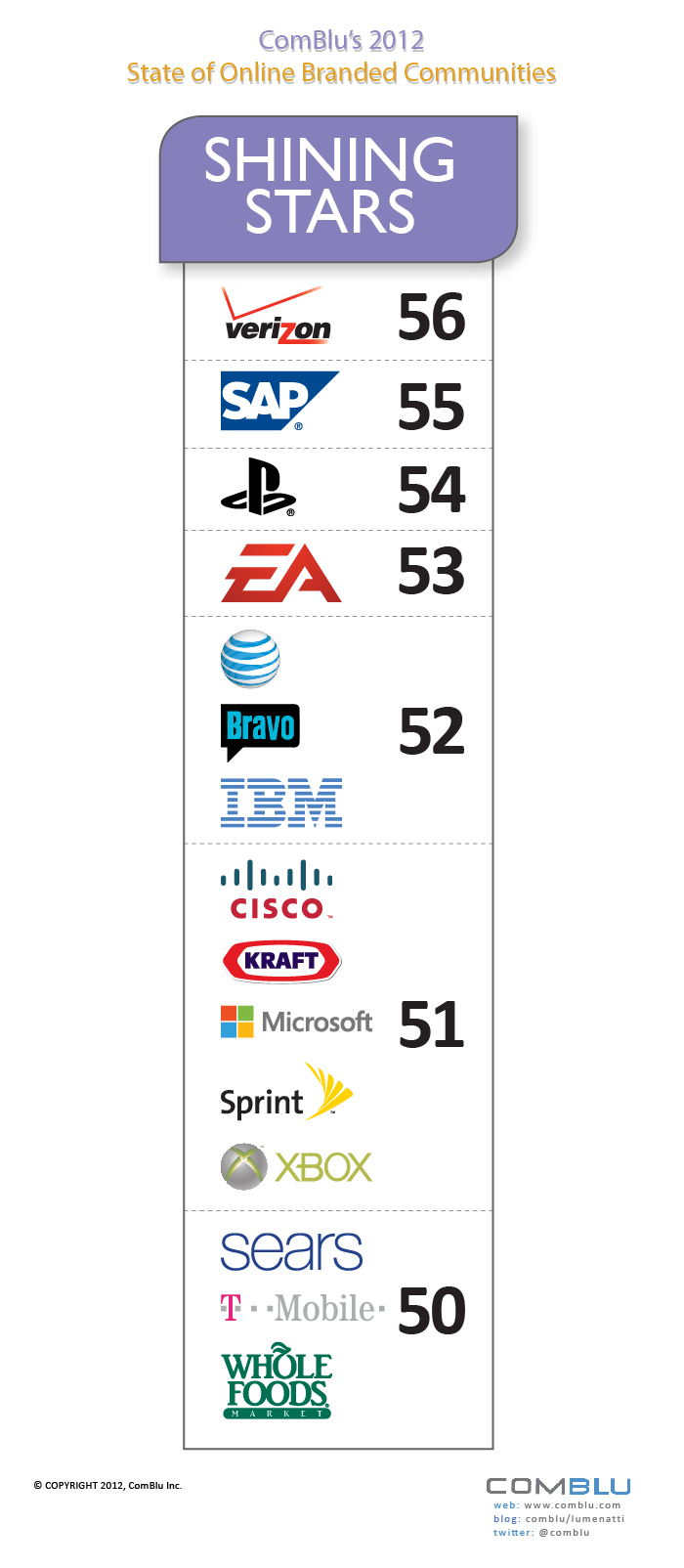
No brand achieved “klieg light” status but Verizon came very close with 56 points and once again is the study’s highest-performing brand. SAP maintains the number two position followed by Sony PlayStation in the third slot, an honor it shared last year with two other brands.
Overall, 30 brands made the high wattage category, but only 15 brands scored 50 or more points, up from 12 last year. Three of the brands with 50 or more points in 2011 dropped off that list. Intel, American Express and Discovery all lost points for dropping from a cohesive strategy to experimentation.
Once again, we put the spotlight on four brands that demonstrated cohesive, strategic approaches to their online community programs.
· SAP is a community superstar and remains one of the highest-scoring brands in the study. Through its community network, SAP engages with more than 2.5 million members and yet provides each a streamlined and compelling experience that is aligned with expressed needs and interests.
· Mountain Dew offers its uber passionate fan base a true “community without walls” experience by serving up a great mix of content and crowdsourced campaigns across branded community and social sites such as Facebook. This community is an engagement superstar and closely aligns engagement activities with business mission.
· Whole Foods continues to be a high-scoring community and employs social media in a strategic and interesting way. Its use of Pinterest, for example, is widely touted as a framework for defining Whole Foods as a lifestyle brand, rather than just a purveyor of high quality, organic products. One of the brand’s most popular boards is “Super HOT Kitchens”. The grocer obviously isn’t in the kitchen remodeling business but kitchens and cooking are a big part of their consumers’ lifestyle experience. While this seems an obvious tangent, it is a lesson many brands fail to translate to their social engagement framework. Too often, brands focus solely on their products, campaigns and coupons to the detriment of a longer tail engagement approach
· Members’ natural passions for sports make ESPN a highly-active community. Through ritualized experiences, members engage in discussions before, during and after games. ESPN really understands who its audience is and what they want out of a sports site. Fantasy games (baseball, football, etc.) and content customization is appropriate for this demographic, as these sports fans are highly competitive and have strong preferences for which sports and teams they follow.
You can see the full case studies inside the report. Don’t miss the industry section in the back where some of the most interesting data is found. Many industries have valuable lessons to impart and our analysts have mined some great nuggets.
The infographic gives you another peek into the 2012 findings. Better yet, download the study and leave your comments.

Principal
Engaging your customers is at the heart of successful marketing programs. For more than 20 years, Cheryl has been building and executing content and thought leadership strategies designed to do just that. She is excited to be applying that well-honed skill to a help companies like Microsoft, Cisco, 3M, Intel, Capital One and Barclaycard tap into their stakeholder communities and build sophisticated content strategies.
Her experience base spans a range of industries – from technology and financial services to retail, travel, consumer products and healthcare. Cheryl has served as an integral member of her clients’ marketing teams, providing counsel on marketing and brand strategy, thought leadership, media relations, product introductions, and event management.
Prior to joining ComBlu, Cheryl spent 10 years leading corporate marketing for large, complex organizations.