ComBlu is a social business and influencer marketing firm that amplifies influence along the stakeholder decision journey and maximizes the voice of the customer.

HomeLumenatti → Archives

Subscribe to Lumenatti

Tags

HomeLumenatti → Archives
  • Pam Flores
    04.24.2012

    Repositioning A Venerable Brand

    Repositioning a venerable brand needs to both honor its heritage and create a new reality that is credible and disruptive. The disruption breaks the schema that has previously defined the brand, but if the disruption is too far afield, the new positioning will lack believability and authenticity and ultimately will fail to connect.

    When ComBlu was asked to be part of the team to reposition Encyclopaedia Britannica, we searched for a platform that blended the old with the new. Part of the process was learning both the brand’s history and grasping the vision of its future.

    What surprised us most at the outset was what we didn’t know about the company. When we thought of Britannica, we thought of the multiple volumes of encyclopedias lined up on the shelf like toy soldiers. We all had fond memories of using the books during our own school days, but even those of us with kids and endless research projects (myself included), had no idea of all they had to offer today.

    We learned that Britannica had spent the past two decades transforming the company into a thriving, global digital education and instruction company. Today, the firm is well-positioned to make an even greater contribution to education and gain a significant share of the $10 billion school curriculum and digital learning markets.

    In addition to the encyclopedia—print and online—Britannica offers a diverse range of digital products and services, including instructional programs for the classroom, reference and education portals, language courses, and educator tutorials for knowledge seekers of any age.

    With its audience-specific, segmented product line, Britannica is well-rounded and thriving. But who knew? We did not, and as we learned through the listening program we conducted, we were not alone. Our listening revealed that:

    · Britannica was not included in much of the conversation about online access to information and research.

    · Many mentions of Britannica were nostalgic in nature and not forward-looking.

    · Conversations often reinforced a perception that the company is outdated.

    So, we definitely had a challenge on our hands. We knew we needed to find the right news angle to reintroduce and reposition Britannica as a global digital brand.

    The sunsetting of the print set of Britannica provided the perfect platform to present who Britannica is today, what differentiates them in the competitive online research arena, why now is the right time to go all digital, and showcase their plans for the future. We used this event as an opportunity to tell the story of the new Britannica to a mix of influencers who could tell the story and give it perspective, context and power.

    It was a fully integrated social and traditional media campaign that used a variety of assets that collectively created “lightning in a bottle.” All of the elements we created to tell the story had distinct roles and made it “easy to care; easy to share.” People were very attached to the legacy print brand so we made sure they had plenty of images and stories that reignited a deep emotional connection to the brand. We also included assets that showcased the “new” Britannica as a powerful digital and social suite of products. The result? More than 2 billion impressions that told the story in a respectful yet disruptive way.

    Our infographics were shared wholesale and tidbits from them were used in various stories; segments of the B-roll footage were used in a number of broadcast and online pieces; the blogs and social posts were quoted, tweeted and retweeted; and the photos we provided appeared literally everywhere. Check out some of our favorite clips, articles and social posts that we consider highlights of the campaign.

    When we started this phase of the rebranding program, almost 2,000 print editions were sitting in a warehouse—today, none remain. But more importantly, many people now know the story of a 244-year-old print publisher that has successfully repositioned itself for a long and successful future as a digital learning brand. This campaign was just the first step on a new journey for Britannica.

    I have to admit that I did get a bit nostalgic about the end of the print era. The memory it evoked for me: I was cleaning the room that our set of Britannica’s lived in, dusting them off, and getting pleasantly distracted by perusing a page and seeing where it took me. Do you have a favorite memory of your own? We’d love to hear it.

  • Brian Costea
    04.19.2012

    Introduction to Building a Content Analytics Dashboard

    Content Marketing is a hot topic. Everyone wants to know how they can deliver and amplify great content that their customers will engage with. Here at ComBlu, we’ve analyzed why marketers need to act like publishers, develop systemized approach to content ideation, creation, management and measurement. In short, brands need content a supply chain. Recently, we’ve flipped the problem on its head and begun to parse it in a new way. How would you measure the quality and engagement level of your content? This will be part one of a two part series that explains how to approach a content dashboard.

    Know your assets

    All content is not created equally. Before we can really begin to accurately measure content, it’s key to understand what content is being delivered to your customers at each step of the decision journey. Content that is created by the brand or its customers for the awareness, consideration, preference, purchase and post purchase audiences will each have different metrics associated with them. Make sure to get organized before you begin to build your dashboard.

    Align your tools

    A common mistake that we’ve seen over the past eight months is that brands jump to an analytics or dashboard planning phase before inventorying the tools that are available to them. Be sure that you review what data points are available to you. I know this sounds obvious but it is a very, very important step. Frequently, the awareness and consideration content is created and maintained by a marketing team, purchase content by IT or e-commerce and the post purchase content by the customer satisfaction teams. Just because the content is on a branded website doesn’t mean that all of the content owners are using a like toolset to measure or track the content. As the old saying goes … Measure twice and cut once!

    Select your metrics

    Once you have verified the tools and data points that are available to you, you can begin selecting which metrics align with content depending on where it applies to the decision journey. Your dashboard needs to provide insights further than the number of impressions that you’re generating.

    Here’s a preview of what’s to come on May 8th, when Kathy Baughman will reveal part two of the series which will dive into detail on aligning your metrics.

    Awareness Consideration Preference Purchase Post Purchase
    · Volume of social content· … · E-newsletter subscription· …. · Reviews or stories created· ….. · Average order size· …. · Participation in forums and discussion boards· ……

    How far along are you in creating a content analytics dashboard? What are some of the struggles that you have faced?

  • Colleen Nolan
    04.11.2012

    Infographic Fever!

    During the last two weeks I have a few clients who have been seized by infographic fever. Maybe you know the illness? The primary symptom: no matter what you are talking about it is perfect for an infographic. Luckily, there is a cure: reason.

    Infographics are hugely popular and with good reason. Research tells us they are more likely to be shared via social media than a standard blog post or article. Personally, I love info graphics. They are colorful and when used correctly compelling and engaging. But to be candid, not every idea, data set or factoid collection should be an infographic. And, and not every media or marketing campaign needs one (insert collective gasp!).

    My rule of thumb is to never start by saying, “let’s make an infographic.” Instead, start your development process with a few questions:

    · What specifically are you trying to communicate? A process, comparison or list of key facts?

    · What do want the readers to learn, know, understand and recall?

    · Are facts, data or a process central to your messaging?

    · Do you want our information nodes to be easy to share?

    In other words – an infographic is just another communications tool in your strategy. It is not a strategy unto itself.

    So what does make for a great infographic from a content perspective? The best counsel on this I’ve seen comes from Patricia Redsicker, a content marketer in Maryland. Lucky for us she’s boiled it down to seven easy steps – and, of course, put it in an infographic:

    clip_image002

    Follow these seven steps and you are sure to produce infographics that enhance your marketing and communications strategy.

    During the last few months our firm has been collecting examples of great infographics. Do you have one you’d like to share? Please send it along as well as why you think it is so great. If we get a good response we’ll dedicate a future issue of this blog to sharing what readers think are the best of the best. Send your infographic as well as comments and concerns to: cnolan@comblu.com. Hope to hear from you!

    Filed under: Uncategorized

    one comment
  • Jennifer Voisard
    04.03.2012

    Spring into community


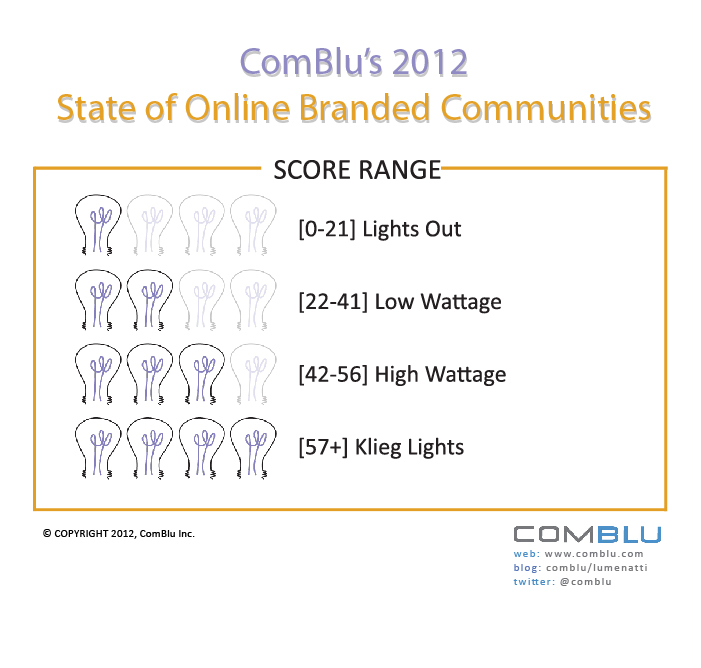
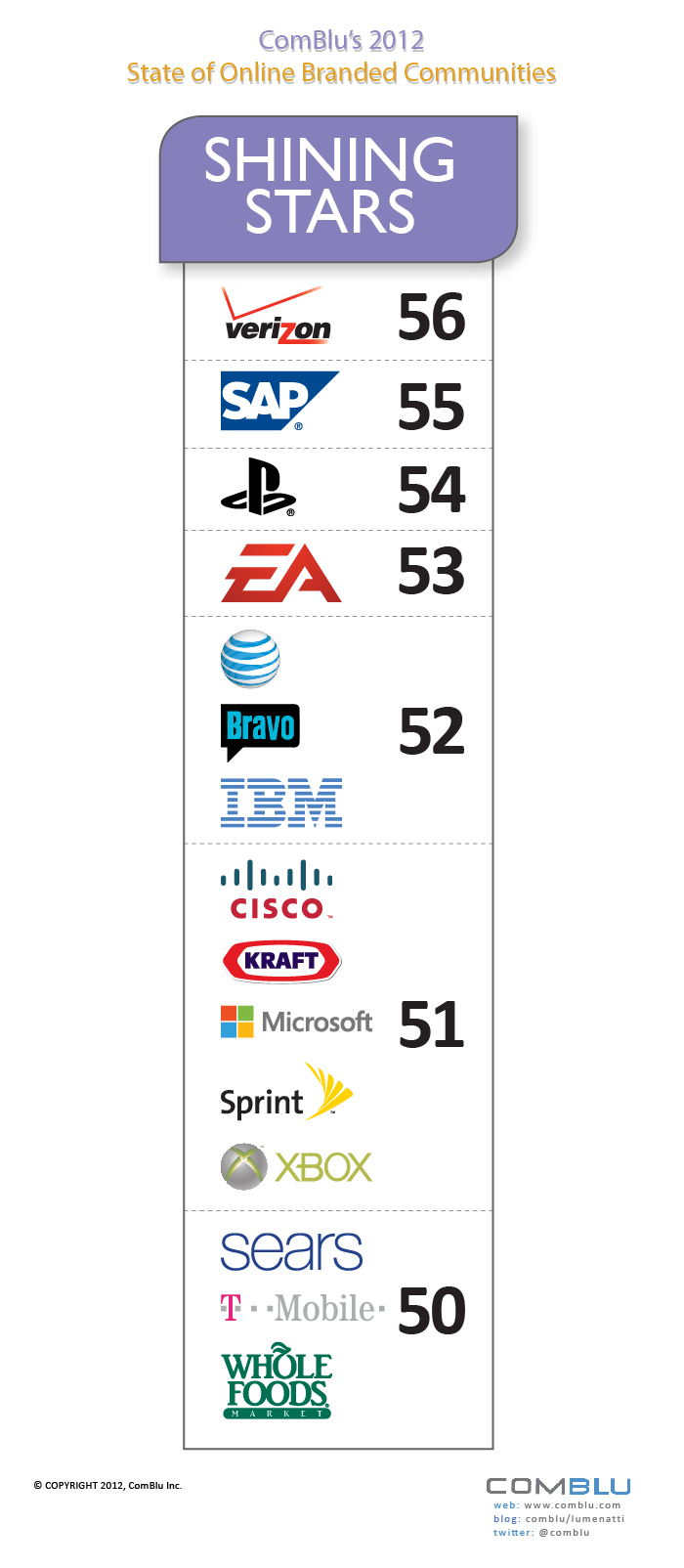
    Cheers to spring. It means gardening, baseball, sunshine, barbeques and the promise of summer. It also means that ComBlu is busy gearing up for the 2012 State of Online Branded Communities Study. It is hard to believe that we have been on this journey for four years now. We have watched community strategies mature and evolve, and I can’t wait to see what’s in store this year. What brand will finally break into the Black category? Will the Auto industry get off the schneid? How has Pharma dealt with regulations over the last 12 months? Will it be the year for Entertainment?

    In any case, I expect to be wowed. If you are a brand included in our study I will be asking some important questions about your communities:

    · Do you offer a personalized experience that improves with each interaction?

    · Do you publish diverse and quality content? Do you have a balanced mix of branded, social and aggregated content?

    · What are you doing to incent behavior? Is it working?

    · Are you engaging advocates and do you know what to do with them?

    · Do you really leverage all of your social assets? A link to Facebook and Twitter doesn’t count.

    · Did you invest in unique tools and functionality? Think beyond “out of the box”.

    In the ComBlu spirit, I am looking for true innovators who are not content with the status quo. Last year we found that, “optimizing member experience remains an aspirational goal.” This year we hope to find it realized.

    Click here to download last year’s study, and stay tuned for some sneak peeks on what’s in store for 2012.

    Happy spring!

    Filed under: Uncategorized

    one comment
ComBlu Inc. | 875 N Michigan Ave, Suite 1340 | Chicago, IL 60611 | Phone: 312.649.1687 | Fax: 312.649.1119 © 2013 ComBlu Inc.